Technical accounting skills are now central to hiring decisions because employers want professionals who can handle compliance, reporting, analysis, and systems with confidence. As finance functions become more data-led and technology-driven, these skills shape how quickly you grow in an accounting career and how effectively you contribute to business decisions. Whether you work in audit, taxation, controllership, or finance operations, strong technical skills make you more reliable, more adaptable, and more valuable.
Strong understanding of accounting standards
A solid grasp of accounting standards is one of the most important technical accounting skills because it helps you apply rules correctly in real work. Whether a role uses GAAP, IND-AS, or other frameworks, this knowledge improves consistency and reduces reporting errors.
- Supports compliance with statutory and internal reporting requirements.
- Improves accuracy when recognizing revenue, expenses, assets, and liabilities.
- Makes audit reviews smoother because the logic behind entries is clear.
- Helps you work across industries where reporting rules may differ.
- Builds confidence when reviewing notes, disclosures, and accounting policies.
Proficiency in financial statement preparation
Preparing financial statements is a core skill that shows you understand how business activity becomes useful financial information. This is one of the technical accounting skills employers value most because it connects operational data with decision-making.
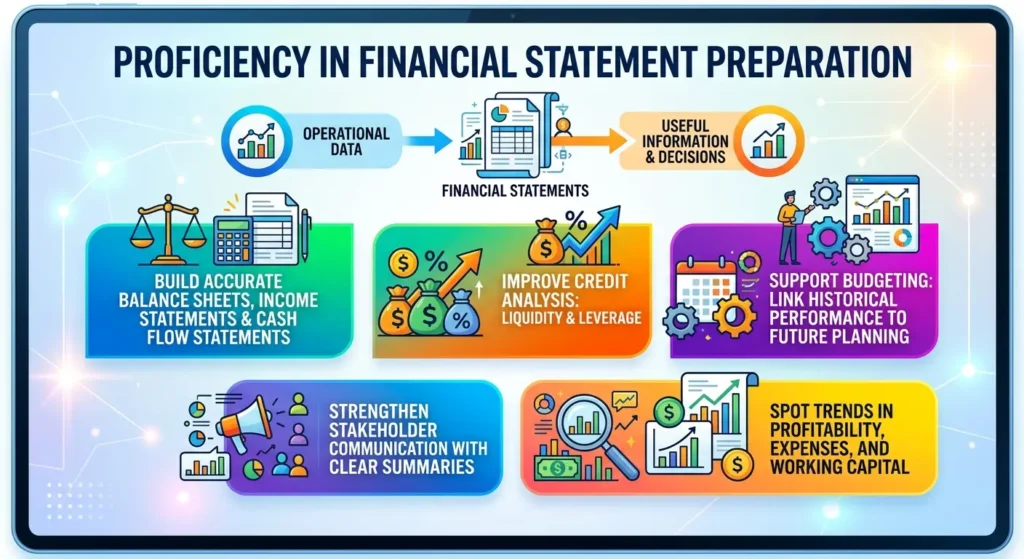
- Helps you build balance sheets, income statements, and cash flow statements correctly.
- Improves credit analysis by showing a clear view of liquidity and leverage.
- Supports budgeting by linking historical performance to future planning.
- Makes stakeholder communication stronger through clear financial summaries.
- Helps management spot trends in profitability, expenses, and working capital.
Advanced knowledge of tax compliance and planning
Tax knowledge is a practical part of technical accounting skills because every business must stay compliant while managing costs carefully. A professional who understands income tax, GST, and corporate tax basics can reduce risk and improve financial efficiency.
- Lowers the chance of penalties, notices, and compliance gaps.
- Helps businesses claim eligible deductions and manage tax outflows better.
- Supports accurate GST treatment in invoices, returns, and reconciliations.
- Adds value during year-end planning and tax provision reviews.
- Helps align tax decisions with broader business strategy.
Mastery of accounting software and automation
Modern accounting work depends heavily on software, so technical accounting skills now include comfort with tools like Tally, QuickBooks, SAP, and similar systems. These platforms improve speed, data accuracy, and reporting consistency.
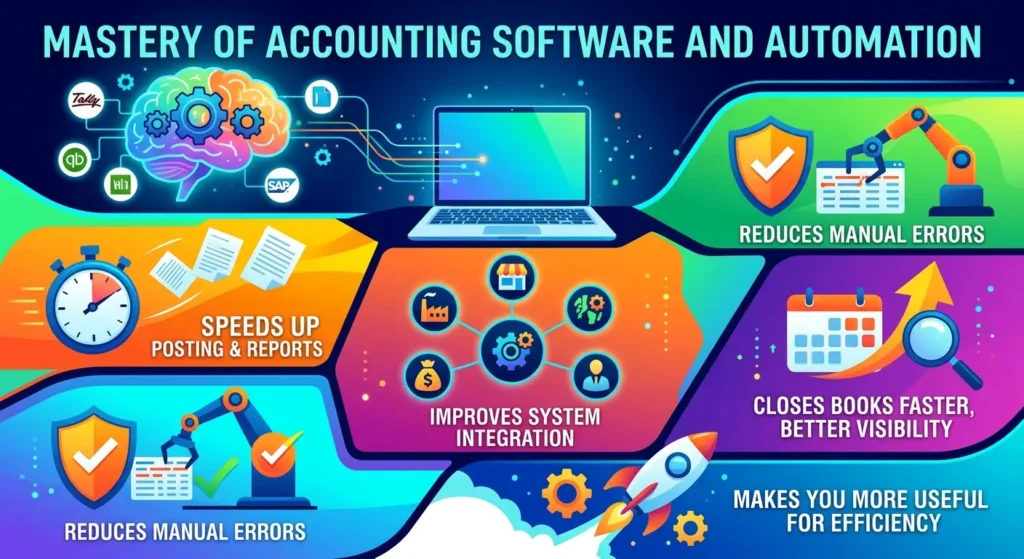
- Speeds up transaction posting, reconciliations, and report generation.
- Reduces manual errors through automated workflows and controls.
- Improves integration between finance, inventory, sales, and payroll systems.
- Helps teams close books faster and with better visibility.
- Makes you more useful in roles where process efficiency matters.
Data analysis and reporting abilities
Data analysis has become one of the most practical technical accounting skills because businesses expect finance teams to interpret numbers, not just record them. Excel, dashboards, and basic analytics help convert raw data into insights that guide action.
- Strengthens forecasting by spotting trends and seasonality early.
- Improves variance analysis by comparing actual results with budgets.
- Supports management reporting with clearer visuals and summaries.
- Helps identify cost drivers, revenue patterns, and operational bottlenecks.
- Makes it easier to answer business questions with evidence, not guesswork.
Audit and internal control skills
Audit knowledge is essential because it helps you assess whether records are complete, accurate, and properly supported. Among technical accounting skills, this one is especially useful for risk management and compliance assurance.
- Helps detect unusual entries, missing documentation, and process gaps.
- Supports fraud prevention through stronger checks and segregation of duties.
- Improves control design for approvals, reconciliations, and access management.
- Makes external and internal audits more efficient and less disruptive.
- Builds trust with leadership by showing control awareness.
Cost and management accounting competence
Cost and management accounting are critical technical accounting skills because they help businesses understand where money is earned and where it is lost. This knowledge is especially useful for pricing, budgeting, and profitability improvement.
- Helps classify fixed, variable, and semi-variable costs correctly.
- Improves product pricing and margin analysis.
- Supports departmental budgets and performance tracking.
- Makes variance reports more meaningful for managers.
- Helps leaders decide where to cut waste or invest more.
Attention to accuracy and regulatory updates
Accuracy is not just a habit; it is a technical accounting skill that protects the business from avoidable mistakes. Staying current with law and rule changes is equally important because accounting standards and tax regulations evolve often.
- Reduces filing errors, penalties, and rework.
- Improves confidence in books, reports, and compliance documents.
- Helps you adapt quickly when formats or rules change.
- Strengthens audit outcomes through cleaner records and better support.
- Builds credibility with clients, seniors, and regulators.
Communication and presentation of financial insights
Communication is a technical accounting skill because finance professionals must explain numbers in a way non-financial stakeholders can act on. Clear presentation turns technical accounting skills into business influence.
- Helps you summarize complex information in simple reports.
- Makes meetings more productive by focusing attention on key findings.
- Supports better decisions by highlighting what changed and why.
- Improves collaboration with operations, sales, and leadership teams.
- Turns technical updates into practical recommendations.
How to develop and showcase your technical accounting skills
Building technical accounting skills requires consistent learning, practice, and visible proof of capability. Courses, certifications, hands-on work, and guided practice can all strengthen your profile over time.
- Take structured courses in financial accounting, taxation, and software tools.
- Practice reconciliations, journal entries, and report preparation regularly.
- Add accounting certification details to your resume and LinkedIn profile.
- Mention measurable outcomes, such as faster closing or fewer errors, in interviews.
- Show examples of systems, reports, or process improvements you have handled.
Conclusion: Investing in your technical accounting skills
Strong technical accounting skills can open better roles, improve your confidence, and make your work more trusted across teams. They also help you stay relevant as accounting becomes more digital, more regulated, and more analytical. If you want steady career growth, focus on structured learning and regular practice. For many learners, joining an accounting institute in calicut can be a practical step toward building stronger capabilities and preparing for real-world accounting roles.
FAQ
What are the most important technical accounting skills?
The most important ones usually include accounting standards, financial statement preparation, tax compliance, accounting software, and data analysis. These skills help you handle core work accurately and confidently.
How do technical skills help career growth?
They make you eligible for better roles because employers value people who can manage reporting, compliance, and analysis. Over time, they also help you move into senior finance and leadership positions.
Can non-commerce graduates learn technical accounting skills?
Yes, they can learn them with structured training and regular practice. Many concepts become easier once you understand the logic behind entries, reports, and controls.
How long does it take to build strong technical skills?
It depends on your starting point and how consistently you practice. With focused learning and hands-on application, you can build a solid foundation in a few months and keep improving from there.
Should I join an accounting institute in calicut to improve my technical accounting skills?
If you want guided learning, practical exposure, and interview-focused preparation, it can be a smart choice. A good institute can help you build confidence faster and stay aligned with current industry needs.